Wednesday, May 23, 2012

How many senses do we have?

"The senses, being explorers of the world, 
open the way to knowledge."
Maria Montessori


We typically think of ourselves as having five senses - sight, hearing, taste, smell, and touch.  Through these senses the world outside of ourselves is mediated into our brain, and then into our awareness and experience.   It's impossible for us to remember as adults, what it was like to be babies perceiving such a complex and ever-changing world for the first time, learning about it, sense impression by sense impression.  The first sounds, the first music - the first sight of a face, the first sight of a tree - the first touch of mother, the first hurt - the first sweet smell, the first ......  You get the idea.  So many first experiences, and this process which begins in infancy continues on through early childhood.  It's truly amazing neurologically.


In this area of sensory education Maria Montessori once again excelled.    She carefully examined the five senses and thought about how to help the children clarify, order, and deepen their experiences.  She developed an array of materials which work with one sense at a time - what we call the "sensorial materials," the two shelves right in the middle of our room.  She also further refined the work into nine areas by adding more specific senses:  the chromatic or color sense, the thermic or sense of temperature, the baric or sense of weight, and the stereognostic, which is the tactile or muscular sense.

The many sensorial materials and the different ways they can be used are at the heart of our work with children.  In these first  photos, you can see Konrad working with the sequencing of colors, from darkest to lightest shade.  No other sense is involved, it is pure color awareness.
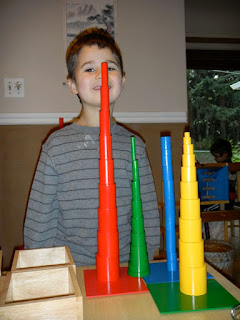
Megan was matching the sound cylinders, again a single-sense experience, simply hearing.  Trevor was using the colored cylinders to build towers - his sight, touch, and  stereognistic senses were involved.  Terra was using only her tactile sense to sort and replace the knobbed cylinders (after several younger years of experience with eyes open).


In the last ten years, psychologists and therapists have delineated even more categories which are valuable additions to our understanding of the complexities of sensory development.  Proprioception is the sense of our body's and limbs' position in space.  The vestibular sense is the information from the inner ear, one's sense of position in the world, how head and body move through space. These muscular senses develop at very different rates in different children, and in recent years a whole specialty of sensory integration support has developed among physical therapists.    So these three-year-olds in their spontaneous shared yoga pose?  They are exercising their sense of balance - or our new word, proprioception!


In recent weeks we've had the tasting work out.  It is another carefully isolated activity, exposing the children to sweet, salty, sour, and bitter in a pure form.  In classic Montessori there are two sets of dropper bottles, for matching, but for myself, I decided years ago that it was too tedious to match each taste.  So it is purely experiential, and so much fun to observe how each child handles the experience.

Ava has been most equanimous, willing to taste the "pleasant" and "unpleasant" equally, every time she does it.  The others, not so much! There's no mistaking which taste Lucas was experiencing here - ah the uniqueness of bitter.  I always tell them that the bitter taste is made from plants that are good for their bodies (it's actually "Swedish Bitters" from New Seasons, diluted.) Funny how Erin and I find that the sweet dropper bottle becomes empty faster than the others do!

So here are your children at Chickadee, absorbing and ordering their impressions about the world, step by step, using every single sense separately and together.  This development continues over their months and years of primary Montessori, and this work has a tremendous cumulative effect, in building sensitivity, intelligence, and awareness.  It's not something they will be able to tell you - "Mom, I was working with my tactile sense today."   At most, you might hear, "I love the tasting work," or, "I built the tallest tower."   But you can know that every sensorial activity has multiple benefits, and you can remember that, in Montessori's words,  "A child is by his nature an avid explorer of his surroundings, because he has not yet had the time or the means of knowing them precisely."


Wednesday, April 25, 2012

Outside on a sunny spring day

“Let the children be free; encourage them;  let them run outside when it is raining; let them remove their shoes when they find a puddle of water; and, when the grass of the meadows is damp with dew, let them run on it and trample it with their bare feet . . .”   Maria Montessori

On our recent, gloriously warm and sunny Monday, I kept the camera at hand for half an hour while we were outside.  Here is just a bit of what I saw....

Our new overhead bars have seen a constant flow of children discovering what they can do -  hanging, crawling across the top, learning to drop, taking turns and giving each other a little space.  The kids will definitely be getting stronger arms!  We are all thrilled about this reclaimed and wonderful addition to our outside, and so grateful for your generous work party, and especially to Cara's dad Craig, who put a lot of time into making it a free-standing piece of equipment.  
We also added a small "rock-climbing wall" to the side of the stump.  Here I witnessed another flow of kids going up and down.  Before now, access to this magnificent stump was limited to the children who could scramble up on their own - I almost never lifted them up.  And with lots of use over these 18 months,  the first natural handholds had broken off.  

Pretty soon, Cara and Zoë headed for the chicken pen.  Cara picked up three hens one after another  - Blue Star in this photo, then Blackberry and Silver Water.  She is one of our dedicated "chicken whisperers," and goes in there often.  It's so nice when it's not so muddy!   Zoë is just getting to know the girls, and watched Cara with admiration.  She checks for eggs every day.  Soon she will be picking them up too.

Meanwhile, Leo and Brady saw me digging out the old straw in the corner of the pen (it makes great, rich mulch and compost material, and right now I am trying to do a bucket or two every day). They said, "Let us do it!" and ran for shovels.  They were seriously digging and filling that wheelbarrow ... until they found a most amazing worm.  It must have been at least 10 inches long, maybe a foot when it was moving.   

Then I found June Marie, who, inspired by the sunshine, had remembered an experiment we did last spring and went to get the magnifying glass, all on her own.  I found her squatting down with a dry leaf, trying to get it to smoke!  She didn't remember how to really focus the sunlight through the lens, so I showed her, and we watched a tiny curl of smoke wisp its way upward. And yes, I asked her to be sure I was with her when she tried it again.
Now the energy had shifted out to the front yard, and I found three kids just chatting and snuggling on the grass, and another two on the picnic blanket - pure joy.  The morning play time closed with a most wonderful outside picnic.  Today, just two days later, it's back to mud boots.


Sunday, March 18, 2012

Art for art's sake!


Art is constantly happening at Chickadee, from quickly-done scribbles, to drawings and paintings, to focused art lessons, to illustrations and story pages about animals and people, to special projects which we set up and support.  All of these experiences are a rich aid to the children, as they begin to discover and express the immense creativity which lies within, such a vital part of being human. 

And what are our goals in supporting and encouraging all this art?  Not all Montessori schools have such an extensive and active art curriculum, but through the years I have come to feel very strongly about its importance.  I believe that it awakens within the children the potential for creative thought and imagination, for making connections, for awareness of beauty, and for self-expression.   It celebrates their differences and honors their developing skills.  It stimulates different parts of their brains and weaves a rich neurological web.  And it's fun....
   
Look at Megan proudly holding her "haunted house" from last Halloween. I do love these special projects!  The younger ones, three or four years old, couldn't have done a collage like this successfully on their own, but with our assistance and guidance, they were totally engaged in making their own scene.  Our "assistance" might mean holding the paper for a younger child while she cuts with scissors, or pointing out how the roof can be a triangle. None of it is done for them, they feel fully empowered.  When finished, the kids all loved having them up together, and then they had a keepsake to take home for Halloween, and with luck and your support, discover again next October!

So we keep the basic tools of art available all the time - water colors and oil pastels, crayons and pencils, easel and tempera paints, scissors and lots of paper.   We give basic lessons in how to use the different art mediums, we encourage, and we observe.  We always honor that the process is more important than the product.  At the same time, usually when asked, we also describe what we see in detailed and concrete terms, without false praise, affirming their efforts, asking questions, listening to their perceptions. 

We also give focused art lessons, like this recent, wonderful sequence on the values of color - the tints and shades which make color, paint, and paintings so interesting. What a discovery for them!  We gave individual lessons in how to create the tints by mixing white into a color on a pallet, bit by bit, and watching the resulting sequence, and then the shades, using black instead of white.  As always, each child had his or her own experience and learning when we gave these lessons.  Then as they happened, we put the color strips up for each other to see, which made the experience more impactful.

The part I had never done before was to have them use tints and shades in an earth-and-sky painting, based on a Van Gogh landscape - a lesson idea I found online, as I read more about tints and shades.  It was amazing!  Each of these seven children became so totally engrossed, and I simply sat near them, giving only the smallest amount of guidance.   The child's creative process always includes elements of joy,  peace, excitement, and wonder, and for each one, it is very personal.  I try to draw your attention to these projects by using the big bulletin board and walls, but unfortunately, it's not possible to share the magical process itself.   You can, however, find ways and create opportunities to witness it yourself, at home.

Another new and more formal aspect of our art curriculum is a great set of many sequenced folders of art postcards.  I purchased them and prepared and organized all the folders during Winter Break, and since then the children have been exploring the folders little by little.  The postcards are organized, first pairs of very different and distinct works of art, to two pieces by each of five or six different artists, to themes, and finally, to styles of modern art like Impressionism.  It's a wonderful, open-ended introduction to fine art.

Last week I sat down with Ava as she did this folder in the second set, two pieces by each artist, to match and examine, with six artists - Degas, Audubon, Chagall, Goya, Mondrian, and Manet. She looked so closely at each painting, almost enraptured, and I managed to write down some of her comments: "How did he paint the glass vase?" [We looked in detail at the colors he used.]  "Look at that tiny person."  [I reminded her again that these are small reproductions of big paintings.]  "I wonder how he got that white right there on the horse - maybe he just did a little tiny dot." "How did he make that ballerina look like she is moving?" "I'm thinking about how he did the windows in the house...." 
  
Which leads us full circle to Trevor painting the flowers at the top of this blog.  He had just looked at a set of postcards, all vases with flowers done by one artist, Redon.  He chose the one he liked the most,  and he proceeded to paint his own version, and another the next day.  This was part of a new explosion of "art from art."   Cara just did her impression of the Turner sea painting above, and on another day Terra tried a Mondrian.  So now you know where these postcards are coming from.  And now, who knows what your child will do this week!?


Wednesday, February 15, 2012

Give the Child the World

"

What does it mean to "give the child the world?"   How can we convey a sense of what the globe really signifies?  How to explain the vastness of the countries that look so small on a puzzle map?   What are impactful, child-friendly lessons about another culture?  These are all questions that Erin and I consider as we introduce geography to the children - we think about possibilities, we experiment, we observe what works.   This year, we chose Asia as our focus continent, after North America, and we are still immersed in learning about it, one day and one experience at a time.

The big picture comes first:  for the 3-year-old child, we always begin with the globe, and it remains central through time, as they begin to recognize and name continents, then countries, and even states.  The globe is of course part of our birthday ritual; its journey around the sun is witnessed again and again, as one child after another counts the years of his life.  

When we're looking at the globe, I often point to my poster on the wall, next to the living room closet - that famous image of the Earth seen from space.  This poster has been with me for years.  I tell them that it was taken by astronauts as they journeyed to the moon in a spaceship, and looked back at Earth.

Then we introduce the flat puzzle map of the earth, with its two hemispheres, and with the continents in their iconic Montessori colors - North America orange, South America pink, and so on.  We sing the song of the continents often, we match animals to their home continents, we play games like "take this boat from North America to Africa."  Little by little it comes together in the child's mind.

And now we're in Asia. We began with some classic Asian animals,  like the panda and the tiger.   I purchased a full set of the Asian biome materials in December, after the kids worked through the North American cards so energetically before Christmas.  So we have the Asian biome map, very different from Asia's map of countries, and out on the shelf are sets of cards about Asian animals and peoples from different biomes - desert and mountains, tropical forest and grasslands.  The kids used these cards as inspiration for January's wonderful Asian animal art project.  

We also have the Asia biome readers, which they often use to guide their writing and drawing in their "story pages."  The biome booklets each have 6 cards to illustrate them.  The first booklet (about the nice, phonetic yak) can be read independently by our early readers, and then each one adds more phonetic elements and words to each page.

But what about the people, the cultures, the incredible diversity of our human family?  Again, we can only give glimpses.  I sat down with the whole group last week, and asked them, "What do people really need to live?"  We talked about "needs" versus "wants" and it began to click.  We brainstormed this list, which I wrote down with them watching, and it wasn't just the older children either - Morgan just lit up when she said, "People need water!"  So, this is their list: people need ______to live:  

* air - and another child said oxygen
* houses or shelter (I introduced the term 'shelter')
* water        * food
* someone who cares about them    
* clothes    
* transportation

Here is some more of their art:  Terra's Mongolian felt yurt, in the high grasslands; Trevor's desert home, made of mud and straw; and below, Konrad's mountain biome home where "...the pepol liv in stone hous"; and Cooper's grand Russian "casul" with golden domes.

After thinking about houses, we shifted to transportation, which led to our listing animals that people use.  The kids came up with all these: horse, camel, elephant, yak, dog, oxen, pony, donkey.

At the same time, we started a list of things people want but don't need.  We'll keep adding to this one, it's pretty much a lifelong lesson, isn't it?   I could just see the wheels turning as the kids thought of things they take for granted but maybe don't really need - socks, plants, fish, cars, art, treats, toys....

Another aspect they're exploring are the flags of Asia.  Over time, the kids begin to understand that each country has its own flag.  I chose 13 for Asia (out of 40+ - not an easy choice!)  We have flags from north, south, east, and west Asia, the main countries, and then a few with fabulous flags, like a dragon flag for Bhutan, sword for Saudi Arabia, and of course the Nepalese flag, the only one in the world made with triangles.  In the top photo above, you can see Kai matching the countries to their flags and labels.  All of the older children have been working with these flags and this puzzle map.  

We also celebrate with occasional, special projects that engage everyone, like last week, when Noriko brought in her mochi maker.  We put out little bowls with three kinds of rice for them to see, including the tiny sweet mochi rice, and talked about how important rice is in Asia. This special rice soaked overnight, steamed in the morning, and then Noriko began the grand making of mochi.  So much fun, and most kids loved the mochi!

On the same day, we watched a Youtube of a "mochi festival" - it showed the men pounding the mochi with huge mallets instead of the modern electric version, accompanied by taiko drums.  Very impressive!

Origami projects are ongoing, again thanks to Noriko.  She's told us that it's a core experience for children in Japan, they work on their origami skills for years, and it's excellent work for them developmentally.  You've probably seen your children's origmai projects coming home.  There's a lot of careful folding in each one.  Right now, the kids are learning to do a little folded fish, with the added delight of a magnetic fishing pole.

While writing this, I stepped into the art room, and found Megan sitting with Noriko, in full folding concentration, so I grabbed the chance for one more photo to go with the finished fish below. Fifteen minutes later, Megan came into the office with fishing pole in hand: "Look what I made!"


Yet another thread in this Asian fabric we weave are all the stories and books about Asia.  A few weeks ago I read my full set of Jataka Tales, ancient Buddhist tales which have been adapted for the children of today, beautifully illustrated, tales about animals that celebrate the power of action motivated by compassion, love, wisdom, and kindness.  So positive and uplifting. They listened to these tales with such attention, and I heard them talking about them afterwards.

Finally, have you seen these characters lying on the first shelf inside the door?  One is the Japanese character for "tree," the other is the character for "forest."  Wonderful! Forest and trees - it seems symbolic of this work, sometimes looking at the single trees, sometimes seeing the forest....  Ava is practicing on the "Buddha Board" which also sits there - it's a water-painting board whose images evaporate, and the technique is much like using the brush and ink that calligraphers use.

And so Asia unfolds here in our children's house, each day, little by little.  We cannot know what experiences will make a difference in a child's awareness, or which will have a lasting impact.   What we do know is this, in Montessori's words:

"We shall walk together on this path of life, for all things are part of the universe, and are connected with each other to form one whole unity."


"

Friday, January 27, 2012

Making peace - one step at a time


Peace-making skills are such a core component of our learning and growing together at Chickadee.   I use a particular approach with a series of steps, all of which help build problem-solving skills.  These techniques are applicable across many situations, including at home, between siblings, and between parent and child.  The more the children practice them, the more natural and effective they become.

The Peace Rug itself is a focus for the children, a dedicated place where they can sit to communicate and solve simple conflicts.  The rug is also something you can incorporate at home.  Ours is a simple multi-colored rag rug.  Outside, we use the bench as a place to sit and work things out.   It does help to have some special spot that your family agrees on – it becomes a support to the problem-solving ritual.

One of us sits in as a facilitator at the Peace Rug, until the children become experienced enough to do it themselves.  As the children practice and become more comfortable talking this way, they begin to do it informally – especially when playing outside, where many small conflicts arise. 

That’s our goal, of course – to help them begin to develop some self-reliance, flexibility, compassion, and empathy, in the face of the inevitable challenges of their young lives.  And working with them, we adults begin to realize that the process helps us too!


Here are the steps:

Step One: the basic principles of the Peace Rug, which we read and review every time:
1.  We listen to each other.
2.  We care about each other’s feelings.
3.  We use respectful language.
4.  I remember that I am responsible for what I say and do.

Step Two:  the particular way the children talk to each other – using what are called “I-messages”:
1.  I say the person's name, and look at him or her.
2.  I tell how I feel.
3.  I tell what he or she did to make me feel that way.
4.  I say what I want that person to do.

For instance, "Billy, I feel angry when you push ahead of me at the slide.  I want you to be fair and take turns."

Step Three:  the "Playing Fair Strategies."  The children learn to pick the appropriate strategy to solve each conflict fairly.  What will help?
Take turns, listen, talk it over, share, apologize, and/or get help from an adult.

Step Four: a choice of strategies children can use when they want to take turns in a fair way.  The best is simply the one that works for the children involved:
Flip a coin, short straw, rock scissors paper, or hands on the bat (we use the longest red rod.)

Step Five:  the Peace Rug itself.  It offers a place where the children talk about conflicts without fighting or hurting feelings.  Both are responsible for solving the conflict.  They find solutions that they both know are fair.  At the Peace Rug we:
1.  Tell the truth
2.  Listen without interrupting, and give each person a chance to talk.
3.  Do not blame or use mean words.
4.  List ideas to solve the problem.
5.  Choose the best solution.

When the participants agree the problem is resolved, they ring a little bell, put away the rug, and go on their way.

As the children get more skilled at handling things this way, they learn to solve problems without going through all the steps.  But when they do work through the process, it is a wonderful thing to feel calmness return, to hear the magic of the bell, to see the light in their eyes.  It really works.

Wednesday, December 7, 2011

Independence

"These words reveal the child's inner needs:  
'Help me to do it alone.'"                                   
Maria Montessori


Few things are more important to your children than independence.  In the quote above, Dr. Montessori's words were translated from the Italian as, "Help me to do it alone."  Closer to her intent might be the phrase we hear children say all the time, "I want to do it all by myself!"  or "I did it!" - neither of which necessarily means alone.  Here at Chickadee, we encourage children to expand their abilities to work independently, to develop their skills and self-sufficiency, and to succeed at new tasks.  We think through the details and plan ahead.  We start with the simplest needs - hanging up a coat, for instance - then expand into all of practical life.   We set up the whole environment and curriculum to foster independence. Deep intention guides this commitment, because it is so good for children.  

Cara is cutting potatoes for last week's roasted potato lunch dish.  She has had many experiences with knives by now, starting with cutting soft bananas, on to cheese, finally to celery, carrots, and potatoes.  This paring knife is sharp for a child (though any good cook would find it dull).  She has been shown how to keep her non-dominant hand above the blade.  She is absorbed in doing this independent, careful, and meaningful work.  Not every child will be allowed to use the paring knife, by the way - he needs to do the preparatory work first and to demonstrate carefulness.  And with knives, an unobtrusive but watchful teacher is always near at hand.   Also near at hand are other children who are watching her work, impressed, and waiting their turn. 

Independence builds confidence and a sense of empowerment in the child.  It leads her forward joyfully to the next challenge, the next interest, the next learning, whatever it may be.  Her absorbent mind is creating networked, neural synapses of success and strength, connecting left and right brain, and linking her will and her actions, in ways that neuroscience is only beginning to understand.  

In Montessori we focus on supporting that independence because we know we are helping the child's brain and character to grow in optimal ways.  Here are just three out of a multitude of examples....

Megan is sewing a button onto fabric.  She is using a sharp needle, learning to go up and down and not around the hoop, getting that button attached all by herself.   Independence!  What came home to her parents was just a bit of fabric with a button sewed into it.  What could they not see but only guess at? Concentration, confidence, completion of a cycle of activity, pride -  all were integral in such a small package of independent work. Each button matters! 

Leo is filling the land forms with water, a work he did repeatedly this fall.  He poured them ever so carefully, filling each one until it reached a perfect level of water tension, with not a drop spilled, not a drop overflowing.  Behind this focused work were many experiences with basic pouring activities in all their variations, from pouring big white beans to pouring water into tiny cups.  He can now pour independently and successfully in any context - he pours his own water for drinking, he pours his own milk at lunch, he serves juice to friends.  He is skillful and confident.  He is functionally independent.


Terra is our oldest this year, and the only one here with 3+ years of Montessori under her belt.  So when she got paint on a favorite flowered dress last month, she dealt with it.  She went to her extra clothes box and changed into another top.  Then she got out the cloth-washing work, complete with a real scrub board.  She mixed up some soapy water with grated soap, and then proceeded to scrub the paint out of that flowered dress.  She scrubbed and scrubbed until the paint spots were all gone.  Then she rinsed it thoroughly and hung it to dry.

The benefits of such independent work cannot be overemphasized.  Sure, she could have thrown it in our washing machine, or more likely, she could have given it to her mom to throw in the washer.  But instead, she took care of it herself, step by step, fully engaged, self-sufficient, and ultimately satisfied at a job well done.

Yes, the benefits of independence are far-reaching.  And it's not just for a Montessori environment.  An increasing level of independence is a core need for every child in every part of his life, from babyhood on - it's a part of every child's innate drive to "create himself."   It was Wordsworth who said, "The child is the father of the man," but it could have been Montessori.  

Your child is inevitably dependent on you, his parents, for all his big needs, for a very long time.  But through these first, critical years of parenthood and childhood, you can set up your home life so that he or she grows in independence in the daily tasks of life, month by month, year by year.  Yes, it takes lots of patience and a willingness to shift priorities, but it is totally worthwhile. "Help me to do it all by myself" - may these words become a guiding principle in your daily life with your children at home.

Independence!   Here's a visual affirmation - Morgan, exuberantly expressing 
 "I did it!"


Wednesday, November 2, 2011

Weaving the web

No single experience has given me more pleasure these last weeks than reading Charlotte's Web out loud to the whole group.  After many readings through my years with children, it remains for me the perfect first chapter book.   Charlotte and Wilbur never fail to weave a spell of pleasure, discovery, and joy in the hearts of the children who are listening.  And the book never fails to move me too, with its language, its subtleties, and its depth of feeling.

Tomorrow we will read "The Last Day," at the end of which Charlotte dies.   The rumors have been floating, because a couple kids have apparently seen a movie version (I have sworn them to silence.)   We will share the sadness of this part of the story together.  Two or three more days, and the last page will be finished, the book closed, the circle of life celebrated as Charlotte's baby spiders take off on a warm wind.


I wish you could see your children's faces as I read to them.  In the past I have read this book to 5- and 6-year-olds; here in our group, only the two youngest tend to drift away.  They sit rapt on our "story rug" (the carpet next to the sensorial shelves).   Their eyes are watching me, they rarely move, and I know that inside, they are conjuring the story's images for themselves; they are soaking up the language and the feelings.  The chapters are just right in length - sometimes we read just half a chapter, sometimes we skip a day.  The vocabulary is rich and interesting (thank you, Charlotte, who is among other things quite literate!)  There are only the occasional, classic Garth Williams line drawings to stimulate their visual imagination.  Every day we talk about what happened the day before.  Today we laughed and laughed at the funny happenings at the Fair. Sometimes I re-read parts, or a whole chapter to a child who missed it.  It's part of our breathing in and breathing out, for a few more days.

What is its magic?    Here is what Eudora Welty wrote about Charlotte's Web: "What the book is about is friendship on earth, affection and protection, adventure and miracle, life and death, trust and treachery, pleasure and pain, and the passing of time.  As a piece of work it is just about perfect, and just about magical in the way it is done."  All of this in a children's book.  All of this and more.

What is its magic?  Perhaps at its core it's friendship, which dwells at the heart of your children's daily lives.  Tomorrow, and forever, Charlotte will say to Wilbur, in her last hours of life, "You have been my friend.  That in itself is a tremendous thing."