Sunday, April 20, 2014

Dipping our Toes in Europe


"The teacher's task is not to talk, but to prepare and arrange a series of motives for cultural activity in a special environment made for the child."
Maria Montessori

We've held a soft focus on the continent of Europe for the last few months.  When I found this quote, it seemed perfectly relevant for this blog post, because that is what I did - I made available a series of activities for the children.  And then we watched what caught on, who was interested in what, and where the children led us with these materials and projects.    Now we're nearing the end of this cycle, and I cannot honestly tell you what they "learned" about Europe.  What I can tell you is that the children have been engaged, expressive, and creative, as they have dipped their toes into the rich culture of Europe via maps and flags, music and art and story.  So here are some glimpses of the trail we followed.

The Europe puzzle map, with its 40-odd countries, is quite a challenging work in itself, not for the faint of heart!  Rex and Seamus spent a long time that morning putting together this puzzle, and again on other days too.

Plus we had 15 flags of Europe on the map cabinet, and I made little slips with the names of the countries, color-coded to their color on the map.   A few of the older children began to connect the flags with the countries, and we used our great flag book to learn what the colors and patterns on the flags meant.  So a week or two later, Rex worked with Collin and they started matching up the flags to their countries.  I would step in to read to them about one flag at a time.  Then they tried drawing some flags too.


Concurrent with these classic map and flag activities were the materials and lessons about the biomes of Europe, and animals of different biomes.  This was really quite wonderful, because Europe is not known for its animals, is it? And yet here were these three sets of cards - animals of wetlands, forests, and mountains - with all kinds of animals and their unique lives, so much to learn about, so much to love.  Here Brady was working with Evangeline.  He  laid out the whole card set of animals of the wetlands, and told her about the animals he was most interested in.  

These cards were the inspiration for the marvelous chalk art project which all the older children did in March. They chose one animal, from one of these sets, and set to work.  First they drew the animal on black paper - usually with some coaching on where to begin, how big, and so on, but we never draw for them. Then I traced their drawing with school glue.  The next day, when the glue was dry, they could set to work coloring with chalk pastels.    This is Isabel's bittern. Priceless.  They are all priceless.


Another part of these great materials from Waseca are the biome readers - little six-page booklets which each tell about one animal in one biome. The three-year-olds love these booklets as much as the older children do, because we always sit down and read to them, and then they get to figure out which picture goes with which page. Ethan has just finished "The Red Deer," which is now an endangered animal because its forests are disappearing.  Another favorite was "The Water Spider," the only spider who lives underwater; it makes a bell-shaped web under water and carries air down to it with the hairs on its body.  All kinds of wonders!

The children used the biome cards to write many story pages. Just last week Cherry drew a pond skater and copied the words from one card:  "The pond skater feels the ripples from across the water."  There really are endless possibilities that arise out of these cards, with just enough information to pique their interest and lead them onward.  So now your children have formed a connection with this continent through its animals - hedgehog and ibex, polecat and graylag goose, Alpine hare and snow finch.  They know that they share this earth with them all.


Meanwhile, people!  A few weeks ago I pulled together one of my traditional, favorite crafts - "paper people."  I like to put these out for every continent we learn about. Some of the children were so excited when they appeared, and made one paper person after another. Others  never did get into it.  Even with the pre-cut clothes - supposedly showing different cultural costumes - every single paper person turned out unique.  Hey, I love these so much I have two sets of them from past years framed in the office.

On a more elevated cultural level, I found a calendar with some of the stunning and famous buildings and structures of Europe.  I rotated them on the wall, we talked about them, and a few children tried their hand at drawing them.   Here you can see the Eiffel Tower, Big Ben and Westminster Abbey, Mont St. Michel, and the absolutely stunning St. Basil Cathedral in Moscow.  The children are willing to try, they draw freely, they experiment, they give it their best.      

Finally, a really rich and ongoing part of these last months has been this collection of art postcards, "Child-Size Masterpieces," a curriculum developed by Aline Wolf, a long-time, stellar Montessorian. They encompass a carefully planned, sequenced series, which the children explore one folder at a time.  Most of the art is European.  The folders start with simple matching of identical paintings, then similar paintings by the same artist, then four paintings by artists whose names we begin to teach, then themes, and schools of art.  We encourage the kids to take them slow, and to imagine these works in real life. We might tell them when one was painted, or how big it is in real life.  We might ask, "Which one do you like the most right now?" or, "What do you think the artist wanted to express?" or "Would you like to try painting one of these?"

Matching the identical and similar cards works beautifully for the youngest children....

....as well as for the oldest.  The whole series of postcards becomes quite a remarkable journey for a child who is interested in art.

Our first group project taken from the art cards was based on Mondrian, whose stark geometric paintings appear in one of the first folders; his style is perfectly suited to the children's interest and skill level.  No one was unwilling to do this one.


Seurat's pointillist art was the inspiration for the dot paintings. Collin was totally focused and silent the whole time he painted here, and he had such shining eyes when he was finished.  When Seamus completed his glowing, dotted tree, seen in the center of this display, he looked up at me and exclaimed, "This was the best day of my life!"


At the top of this blog is Charlotte's blue pony, which she painted after being inspired by Franz Marc's "Little Blue Horse."  She was so thrilled with this horse.  And this is Cara's interpretation of Fragonard's "The Swing."  She was enamored with this wonderful, soft, glorious painting, and totally satisfied with her own swinging girl. 

While some of the Europe materials are put away now, these cards stay out, and these explorations with the art cards will continue on for as long as the children are interested.  Some kids have done most of the cards, a few are just beginning. None have yet discovered that the last set is a whole collection of transportation art - from foot travel to boats to trains to automobiles.  I know some kids who might discover their first timeline if and when they get there!

Another central aspect of our cultural journey in Europe has been music, but that has just become a separate blog post.  For now, I will let Brady's little bearded reedling, a bird of the wetlands of Europe, sing you its simple farewell song.


Tuesday, April 1, 2014

We're back!

"The child builds his inmost self 
out of the deeply held impressions he receives."
Maria Montessori

Cara is sitting in flowers.  How perfect is that, for the first day back! 

After a long and mostly rainy Spring Break, the children all tumbled outside today, rejoicing that it wasn't raining and that they were all together in their Chickadee land again.  Ten days away, and the visible signs of our new spring are all around. The "protected areas" in the forest are filled with green, mostly the abundant waterleaf, but many other plants are emerging too. These protected areas have worked out better than I dreamed. The first two I circled with stumps.   Since then I've used whatever branches fall, following the children's natural paths, and now we have a network of different protected areas and running paths and open space.   

So the Indian plum has leafed out - it's always the earliest  - while the big leaf maples are in bud. Sprinkled throughout these areas are trilliums and the first native yellow violets. This green, unfolding, and flowing life is what surrounds your children as they play, and as Montessori wrote in the quote above, the impressions they receive become part of who they are.


Each child has his or her own individual experience, every single day.  Here are some glimpses ..... 

Evangeline found one little mushroom, and she stopped to say hello.  I don't know if anyone else saw it.  More mushrooms will be appearing soon.


Collin greeted the earth by playing with sticks, beating and digging - it was as if he were drumming, saying "Hello dear friendly mother earth, I'm back!"

Cherry found the big yellow dump truck filled with muddy water, and she stirred and stirred for at least fifteen minutes, totally engrossed.  She didn't get a bit of mud on her princess dress either.

As soon as I pulled the tarp back off the sand area, Joey and Eleanor plunked down in their favorite place.
Moving wood and branches and building things is a constant enterprise around here.    Ever since the top half of our neighbor's western hemlock fell across the fence last month, and we were rewarded with a bounty of new branches, the forts have taken on a whole new level of elaboration.  Rex is working on one of them; he told me he was "Bob the Builder."  

Seamus is hauling wood from one place to another. I have resolved to bring in more scrap wood and building materials, after reading a powerful article from The Atlantic, called "The Overprotected Kid."  (Link below.)


Meanwhile some other children discovered the camellia tree by the chicken coop, where the ground is now covered with flowers.  They named it the "Pink Land."     Brady and Cara both climbed up in the tree - imagine the beauty of climbing a tree where flowers fill your eyes.  Julian loves to poke little sticks through leaves and flowers and make little umbrellas and other wonders.  


A fantasy game began, complete with a princess and a wedding.  After lunch the game continued, and Joelle, our new assistant, sent me this photo of Cara in the tree with Evangeline looking up at her, just as I was finishing this post. She too was enthralled.  A pink wonderland!


At our morning circle, Collin had announced that he learned how to ride a two-wheeler during Spring Break. So after playing under the trees for a while, he and Rex headed for the bikes, and helped each other with helmets.    The bikes are the speedy way to move through the forest.


Collin is heading down the side road.  This little hill provides a perfect level of challenge for these biking adventurers.  In this case, the bike and he went down a second later - no upset, he got back up and kept going - he explained that, yep, he needs to practice the foot brake some more.  

Another part of every day are these other members of our community.  We let them out to scratch and explore on their own, and they run about as fast as the kids do when they are set free.  If only I could teach the chickens to stay in the forest and out of the flower and garden beds, they would be out more.   It's quite striking how they like to be close to the kids when they are outside  - I don't know if it is familiarity, or if they feel safer with them around, but the hens will stay down below much longer when the children are playing around them.   They behave differently when they are out and the children are inside, or when no one is here but me.    Then they head for the raised beds and the flower gardens, and scratch scratch scratch....


while the kids run run run ... and climb climb climb ... and dig dig dig ... and build build build ... and grow grow grow.


Here is the link to the article "The Overprotected Kid."  It's long, potent, and thought-provoking (though it seems I can't make a live link....)

http://www.theatlantic.com/features/archive/2014/03/hey-parents-leave-those-kids-alone/358631/

Sunday, February 9, 2014

The Forest of Lost Kites

"Of all things love is the most potent."
Maria Montessori


I am reading the first longer book of the year to the children right now, during our story time before lunch.  This is a new experience for the younger ones, carrying a tale in their memory from day to day, and each day we talk about what happened the day before.  It's not a chapter book.  I read it slowly, and give the illustrations the attention they deserve, so it takes about two weeks to reach the end.   I want to tell you about it here, because this book is like no other, and it's part of your children's day right now....

Bill Steidel is an artist and a long-time resident of Cannon Beach.  He has a magical little studio on Hemlock Street, and most of the time you can find him sitting at his mini-station in the corner, working on his latest creation.   I have visited with him for years, ever since my own boys were growing up.  He creates vivid, colorful fantasy paintings, and he also paints naturalist images of ocean and birds and trees and mountains.  His son Sam works with him, creates with him, and manages the business.  They are a Cannon Beach institution.  Here is his website:  http://www.steidelsart.com/

The lovely painting of a Chickadee in the rain, called "Spring Nap," which hangs in its special place in our main room,  is a Bill Steidel work.  You may have never noticed it, but now you will.  Every time I visited him through the years, I would buy postcards of his art, but one year I took the leap and purchased this print, when my sons were young teen-agers.

So what  does this have to do with reading a book? Well, Bill Steidel also wrote one unique children's book, "Mallory in the Forest of Lost Kites."  In 2001 it wasn't published yet - he had made it available in a binder, with the printed pages nestled inside sheet protectors.  Every page is hand-written, and every page is filled with his illustrations.    It is a collector's item., I have a signed copy dated 2002.  Since then they have self-published a hardbound edition.

So in all the ensuing years, I have read this book to the children around me, 3 times already here at Chickadee, with this reading being the 4th. In the summer of 2011, I read it to the children, and then in August we did a family beach day in Cannon Beach.  It was a dream come true for me:  We went to visit Bill Steidel in his studio, and he leaned back and chatted with the kids, and talked with them about what he was working on at the time, a 3-dimensional painting.  The photo at the top of this post is from that visit, and it sits framed on the mantlepiece, another piece of Chickadee's story that I always keep out, and that most people don't notice.  Those children you see have all moved on now, except Cara, who is the shortest one there, kind of hidden, and not yet 4 at the time.

The boy who is reaching his arm toward the painting is Konrad.  He was with us the first two years of Chickadee, and I had become true friends with his family. They moved back east last June, and sad I was to see them go.  But before they left, Kathy brought me a good-bye gift - she had gone to Cannon Beach and come back with the big print of the "Forest of Lost Kites" to give to me; it is displayed now in the art room above the book shelf - a gift of friendship and memory, which will last for always.

So we are reading the story of Mallory's adventure now, and your children can tell you about that painting.  If you look very closely you will see Mallory - a humble mouse in a magical forest - a mouse who shows heroism in the face of danger, heroism and wisdom and kindness.  I won't tell you the story, you can borrow and read it yourself some day.  But I will quote the last page for you, to share its spirit:

"Was Mallory remembered?  He surely was.  Whenever the moon was full, instead of striking fear in the hearts of forest creatures, they would marvel at its beauty and whisper softly, 'it's a Mallory night.' Whenever a kite fell from the clouds the young would point and shout, 'Here comes a Mallory.'  And whenever a soft evening breeze wove its way through the tree tops causing them to sway, and the forest floor danced with color, it was called 'A Mallory kind of day.'  Was Mallory remembered?  Oh, yes, he was indeed.  Whenever anything wonderful or exceptional happened in the Forest of Lost Kites you could hear someone exclaim, "now THAT was a Mallory."


Sunday, February 2, 2014

Many Kinds of Smart


The first duty of an educator is to stir up life, 
but leave it free to develop.
Maria Montessori

Multiple Intelligences!  Is this new news or old news?  I decided that it's worth revisiting, to remind both you and me that your children have multiple intelligences, not just one. Howard Gardner first published his theory of “multiple intelligences” in the early ‘80’s. In his first, groundbreaking work, he questioned the primacy of the IQ test to measure intelligence, and he posited the existence of multiple intelligences in every human being. Progressive educators and thinkers embraced his theory, and expanded upon it, and so did he.  Many Montessorians recognized in his work a new vocabulary to express the benefits of our rich, respectful, multi-sensory learning environments.  (Unfortunately, we do not see a deepening support of multitple intelligences in public schools, rather the opposite.)

Gardner's system still resonates with me, perhaps because I like to organize my perceptions and thoughts about children in different ways. This winter I have found myself remembering it again, as we've focused on space; you'll discover why at the end of this blog.  

It’s important to understand that Gardner’s approach is really a symbolic way to explain our complexities and our unique differences. Our patterns of intelligence cannot actually be separated out and analyzed alone; they always interconnect and support each other. At a lecture by Gardner that I attended perhaps ten years ago, he emphasized that every person has capacities in all nine - that is what makes us human - and that no two people have the same spectrum or blend of intelligences - that is what makes us unique..

In these simplified descriptions, I focus on your children here at Chickadee, showing examples of activities that help develop each intelligence. As you go through them, see if you can more clearly identify your own children’s preferences and unique gifts. Also, you can ask yourself, in what ways are their tendencies similar to yours, and how are they different from you? How can you encourage and support their development in different areas?


1) Linguistic intelligence: These are the children with well-developed verbal skills, and a natural sensitivity to sounds, rhythms, and meanings in words.  To develop this critical area, we have the movable alphabets, vocabulary cards, 3-part cards, command cards, rhyming activities, verbal word games and poems, and the whole sequenced array reading and writing work.  A strongly linguistic child communicates verbally, develops reading and spelling skills with relative ease, has an excellent auditory memory, enjoys poetry and word games, and demonstrates a proclivity for words, names, places, and facts.   Here is Logan, spelling some first words, and Brady, who just freely "wrote" his first sentence with the movable alphabet - learning about space inspired him!   We always love words like 'atmsfr.'  


2) Logical-mathematical intelligence:   From the first activities with 1 - 10, to the "addition strip board" that Rex is using, to more advanced materials like Cara's "multiplication with the colored bead bars," Montessori is rich in math manipulatives. Every child works with them, and every child has the chance to establish the best possible early mathematical intelligence. Those who have a particular flair for logic and math compute in their heads early and easily, enjoy logical puzzles and games, choose science experiments which stimulate thinking, and show an aptitude for logical negotiations. They thrive with Montessori math materials, and with any activities which invite the development of logic.


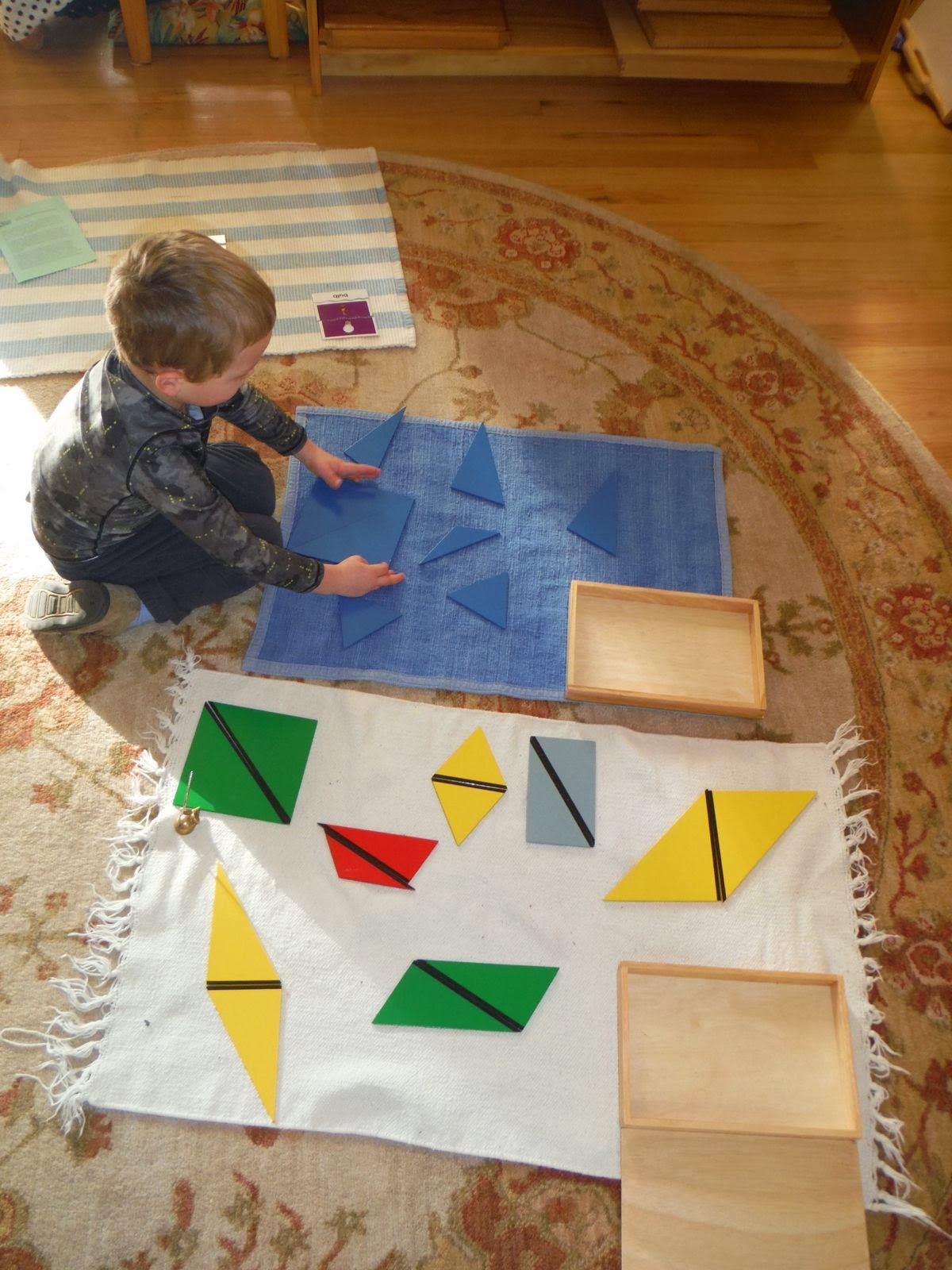
3) Visual-spatial intelligence:   The sensorial materials help unfold and express every child's concrete spatial abilities. Evangeline has worked with these cylinder blocks many times now, and more variations await her. The children with noticeable visual-spatial strengths experience vivid visual imagery, master complex puzzles, adore paint, and might learn more from pictures than words. At home they love blocks and manipulatives, and at Chickadee they return again and again to the sensorial materials and to our art activities.  They benefit from using the visual movable alphabets, and they master multi-step activities like chair scrubbing.


4) Bodily-kinesthetic intelligence: These children need lots of movement, excel at sports, show excellent fine- and gross-motor coordination, enjoy clay and other three-dimensional art, and thrive with gymnastics and dance lessons. They master all our practical life activities, love the challenge of advanced walking on the line, need lots of playground time and lots of movement . They may have difficulty sitting still for long; they often have trouble remembering that "inside we walk, outside we may run."  Thank goodness Montessori has built-in movement throughout the day!

5) Musical intelligence:   The children with particular musical gifts sing and hum spontaneously, learn songs easily and make up their own, appreciate musical variety and beauty, and move rhythmically.  Gardner considers this the first intelligence to manifest itself – a very early sensitive period. High musical intelligence can be both intuitive and logical/mathematical, and we can help the child develop both aspects. Seamus particularly loves music, and though it's hard to show music in photos, this one gives a glimpse.  No surprise to find out that his grandfather was a music teacher, which surely indicates both a genetic and an environmental influence!


6) Interpersonal intelligence:  Our community life abounds in opportunities to develop budding interpersonal skills.  There is a constant flow of social experiences happening, but two are worth a specific mention: the ever-shifting relationships between the older children and the younger ones, with the older child getting to experience the role of mentor, and the younger, the experience of being cared for. Isabel and Eleanor share the nurturing work of washing each other's hands and rubbing in lotion:  priceless!  

The other ongoing learning opportunities are in conflict resolution, which in some form or another happen every single day.    Whether it's on the peace rug or in a more informal process, the children slowly, in fits and starts, learn to develop empathy, kindness, a willingness to accept responsibility for mistakes.  Sometimes I wish it happened a little less, and then I remember how critically important this development is.

Gardner's term "Interpersonal Intelligence" has been brought into the public eye now as Emotional Intelligence,  or EQ, with Daniel Goleman's important work.  Recent studies have confirmed that EQ is a greater predictor of success and happiness than other factors like status, IQ, or income.  Children naturally strong in this area make friends with ease, express caring and sympathy to others, enjoy games and group lessons, and often show a natural leadership in their group. They love circle times and gatherings, shared lessons, tea parties, group games.  They learn to handle conflicts in a kind way, and often mediate for others.  Children to whom empathy doesn't come as easily get lots and lots of practice.

7) Intrapersonal intelligence:  These children are the introspective ones, somewhere on the introvert side of the scale.   They enjoy working independently and alone, have a strong sense of self, seem especially tuned to their inner guide, and express their own feelings accurately. They thrive with the open choice given in Montessori, and they cherish the freedom to watch others and to repeat activities. We always emphasize every child's right to work uninterrupted (which proves to be hardest to remember for the highly social ones, no surprise there.)   Introspective children are comfortable playing alone when they're outside, at least for part of the time.  Their intuition and their powers of observation are strong.


8) Naturalist intelligence:     I believe that every child holds this deep intelligence, that it's part of his birthright, and that it only needs to be nurtured in order to flourish.   Again, more recent work like Richard Louv's Last Child in the Woods has taken this far beyond what Gardner described, but it still remains true that some children show an innate affinity for the natural world.   They love to explore the outdoor environment in all its minute detail, choose to learn about animals and ecosystems, nurture animals and plants in the school environment or home.  Like Julian here planting his sunflower, they thrive with gardening, hiking, and camping experiences.  In our inside work, some children simply gravitate more than others to the science and nature activities: caring for our plants like Joey, matching rocks or leaves, botany or animal cards, and learning about the biomes.  They are the ones to notice the little details too – the ladybug larvae in the flower garden, a fish who’s not moving, an ant on the floor.  Last week one child found a first ladybug under the overhead bars, cause for a momentary celebration.


9) Existential intelligence:  About 20 years after he published Frames of Mind, Gardner added this one, which he described as the ability to understand things that are too big or too small to perceive, and the proclivity to ponder questions about life, death and ultimate realities. This intelligence manifests more clearly later in childhood or even adulthood, for it concerns the ability to grasp such things as chemistry and the new quantum physics (too small to perceive) and the vastness of space as revealed by the Hubble telescope (too big).   These children ask questions quite early about life and death, why they are here on Earth, and if there is life on other planets. 

In this last month, I have once again observed most of our children showing such an avid interest in space - it's so far from their immediate world, and yet it calls to them so strongly. Could this be a shift in development, for these 21st century children?  I don't know for sure, but I find it striking.  Collin was on fire to draw and write about the space station ("spas stachn"), and after he got it started, every older child wrote their own words and painted their own space reports.    It was a joyful explosion!


Last year I bought a fantastic oversized book, Cosmos, which is filled with Hubble space telescope images; that book has been taken out and leafed through countless times since then; many torn pages, and last week it completely fell out of its binding.  So I try to use words to describe the indescribable vastness of time and space, and I tell them that when I was a little girl, people had never seen any of these images, not even the earth from space; and somehow, within these young souls, it all seems to resonate. Perhaps most important, they express themselves with art about planets, galaxies, supernovas, and space - look at Cherry's "Milky Way galaxy" (she's holding up the Cosmos book). It's all been so wonder-full.  I sit here, writing this, full of wonder.


I hope this post is meaningful to you, I hope that you agree that Gardner's approach to intelligences provides a valuable prism through which to see and understand your children in richer and wiser ways.   For myself, it has taught me that it is especially important to recognize and support those learning styles and preferences that are different from my own.  I love the amazing, challenging, interesting array of traits and strengths that your children display every single day.  Each one of them is "many kinds of smart!"