Sunday, September 22, 2013

At the beginning is a good place to be


"To assist a child we must provide him with an environment 
which will enable him to develop freely."  
Maria Montessori


At the beginning is a good place to be.
What will each day bring for you and me?
New life, new friends, new things to do....
At the beginning is a good place to be.

"At the Beginning" is one of our beloved and familiar Sanford Jones songs - always true, because every day is a new beginning, and especially true in September.  We've been singing this song a lot in these first weeks.

In this top photo, Evangeline is practicing squeezing a sponge, by moving water from one bowl to another with the sponge.  This is a classic "at the beginning" exercise.  Sponges are in constant use in our environment, from the clean-up buckets to the paint trays, from the water-pouring works to food prep.  At the beginning of their Montessori life, every child learns how to use a sponge.

And here we are at the beginning of a new "school year."  For Chickadee, it's an artificial boundary in a way, because we are open year round, and the children really do not know such distinctions.   Ant yet, at the same time, September is also a time of beginnings and renewal:  
  • We have three brand new children, Cherry, Joey, and Eleanor, and two who joined us earlier in the summer, Evangeline and Logan, plus several beloved friends are no longer here.   Relationships are in new beginnings, shifting, renewing, and awakening.  
  • The weather is changing too, the shadows and sunlight shifting, the chickadees coming back, the summer veggies finishing.  We all sense that without a doubt we are at the beginning of a new season.
  • Routines are beginning again -  improved, reviewed, practiced - as we all explore how to live together more successfully and peacefully.  
  • Each child is at the beginning of some new learning or new ability, or a new urge to explore something that had seemed so challenging.  All kinds of beginnings are happening!
So what have the children been doing here in these weeks of September?   Some have been repeating familiar, beloved activities, some have been trying out new skills for the first time.  Some have chosen new and challenging materials, some are working right at the "cutting edge" of their development. Every child has been given a number of lessons in these first weeks - Erin and I track them in our record-keeping binder.  And most wonderful of all, at the beginning of each day, we do not know what each child will do, who will discover something new, who will master an often-practiced activity, who will wander, or what challenges will arise. "New life, new friends, new things to do....At the beginning is a good place to be."

So here is a set of photos for you, chosen out of so many possibilities, our new beginnings in practical life, art, sensorial, math, and language.

First some Practical Life.
Isabel is arranging flowers, as she has many times before, with the added summer delight of choosing and picking them outside, dahlia and cosmos and marigold.

Julian is slicing bananas to serve to his friends.  He's starting his second year with us, 3 1/2 now, and I have never seen him do this work so carefully.  He reconnected with his friends by offering them pieces of bananas.


Eleanor is doing the sink-and-float work.  She is our new youngest, and is revealing herself to be careful and competent.  "I can do it myself."  She has gotten sink-and-float out at least 3 times already - I need to change the objects!


Ethan is "scrubbing an object."   Many supplies are laid out - apron and underlay, peppermint soap in a dropper bottle, a scrub brush, water and sponge and towel. He scrubbed this red car until every bit of dirt was gone. (And then it went back to the forest to get dirty again.)


Collin was the first to try our renewed sweeping work.  Learning to hold a broom properly and to sweep effectively is quite a challenge for the 4-and-5-year-olds.   So on the shelf now the kids will find a box which holds wood chips to scatter, and this wooden sweeping guide which gives them a target, a place to make their pile. Collin did a great job sweeping up every single wood chip.


Now some Sensorial.
Joey is exploring the pink tower, one of the first lessons we give every new child. All over the world, Montessori children are working with the pink tower, every day.
We have asked our "old timers" to hold off on their elaborate marble run creations using the pink tower and brown stair, so that our new kids have some good, simple modeling to witness. 


Colors!  Lots of color work at the beginning of the year, in Sensorial and in art.   In this classic lesson, Evangeline matched up all eleven pairs of color tablets, and while working with her, I discovered how many colors she could name.

Cherry's family just moved here from South Korea; she has been with us for just one week.  In her first days she tried one work after another, and quickly showed us how many wonderful things she could do without speaking English.  Here she has just completed putting all these constructive triangles into one large triangle.  And then she proceeded to make her own design.  I was quite astonished.


Art
We started the year with color mixing, using both colored water and paint as separate works. Logan is mixing colors with the dropper bottles of yellow, red, and blue.  He just lit up as he saw the green and orange appear.  All the kids love this bright and lovely activity.

Then we put out a special, first painting project, drawing an abstract design with black pen, and filling it using only the primary colors of paint.  We emphasized to not let the colors touch or mix together. Ethan drew his own lines, they all did, and you can see how intent he is on keeping that yellow inside the black lines.  Every child's design was freely drawn, spontaneous, and different.

Late last week we introduced the next step, mixing primary colors of paint to create the secondary colors.  Seamus was the first to do it, and once he mixed them, he used the colors he had created to paint a rainbow for the very first time. 


Math.
Meanwhile, in the second week there was a rather sudden explosion in math for some of the older children - again, a new beginning.   Rex looked at the Hundred Board one day and said to me, "I think I can do that now."  Over two days, he proceeded to lay out all the numerals from 1 to 100.
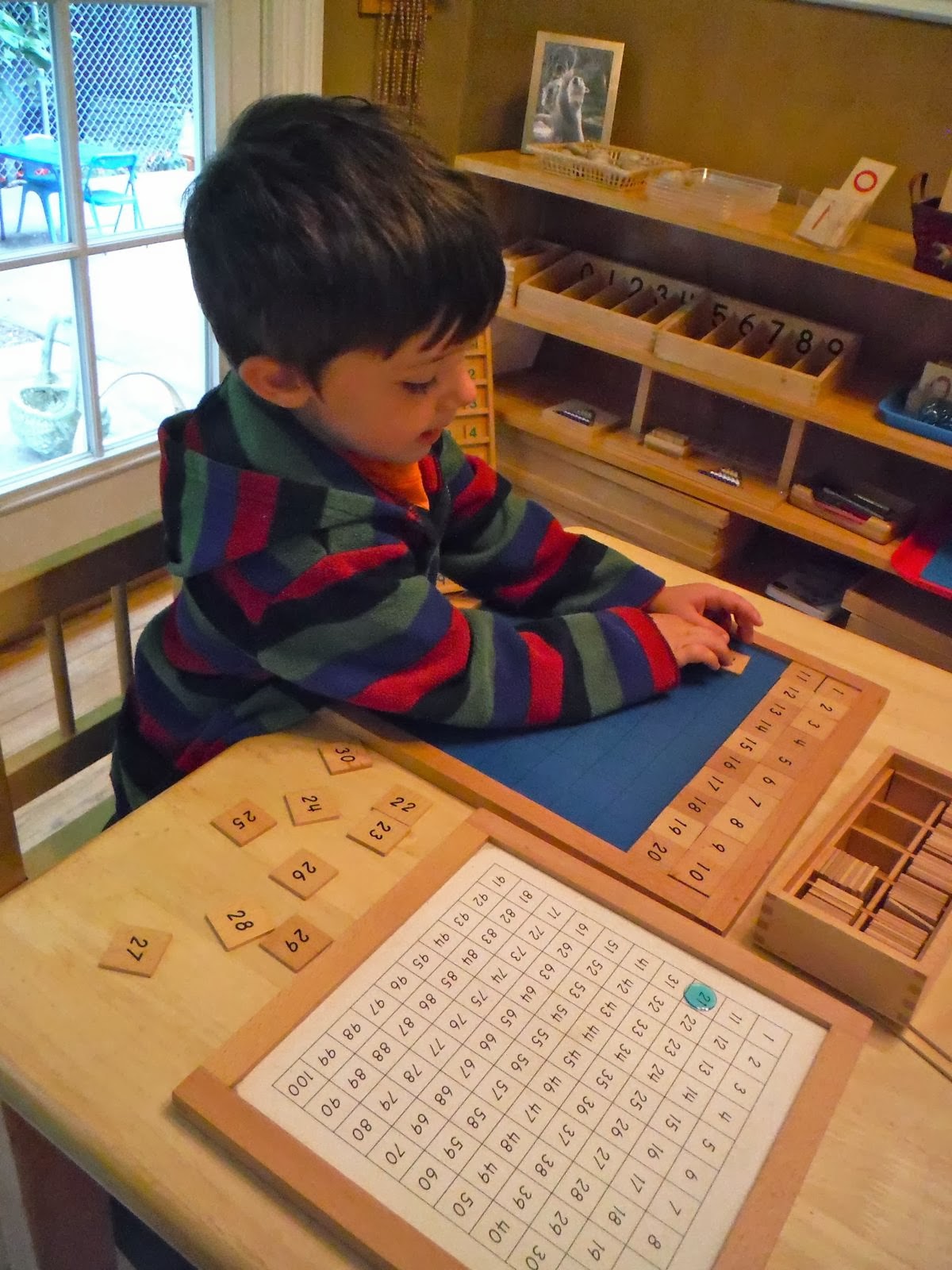
Charlotte did something similar.  She walked by the hanging bead chains, as she has hundreds of times. She stood there running her fingers over them, and said, "I want to do these now!"  These are the square chains;  we use them for skip counting.  Erin gave her the initial lesson and sat with her as she worked - Charlotte carefully and proudly counted them up through the 7 chain (7, 14, 21, 28, 35, 42, 49) in one sitting.


Brady caught wind of all this math and announced that he was ready to practice the golden beads some more.  He got out the tray of beads, showed me he remembered the layout and understood the one's, ten's, hundred's, and thousand's, and so we played some "bring-me" with the beads.    "Bring me six tens.  Yes, six tens is 60" and so on.  Soon he will add the actual numerals to the beads.

And then there's handwriting happening, both letters and numbers.  Left-handed Noah was doing some addition pegs, easy to add but still tricky to write the numerals.   So he practiced writing "rainbow numbers," using multiple colors of chalk,  on the big chalkboard.


Language.
Cara hasn't dived back into math yet; she's been busy doing various reading and writing works. Here she is reading longer, phonetic word cards.  When she came to 'milkman,' she looked up puzzled, and asked, "what's a 'milkman'?"  I laughed and told her about milkmen "in the old days," and then I threw the card away.  It's an anachronism now.

And so these beginning days have flowed one to another, and as I write this, we are only 14 school days into the new year.   " New life, new friends, new things to do...."   And all of it happens, inside and outside, one day at a time.


Sunday, July 28, 2013

A journey of discovery with Lewis and Clark

"Our care of the child should be governed, 
not by the desire to make him learn things, 
but by the endeavor always to keep burning within him 
that light which is called intelligence."
Maria Montessori

Lewis and Clark!  Our oldest children spent the last month learning about the great journey of Lewis and Clark, their Corps of Discovery, and their incredible exploration across a wild continent which we can barely imagine now.  I had an "idea" of how the process would go, with certain projects in mind.  But these children led the way instead, they shaped the process themselves, and it turned out more wonderful than I could have imagined.

Early in July we created the map you can see above, and began to trace the journey.  I gathered collected a set of books about Lewis and Clark, from the library, and quite a few that I purchased. We read them all, a bit at a time, reading sections more than once, overlapping the story from different perspectives, following the journey on the map.  "Seaman's Journal" told the story from the perspective of Lewis' dog Seaman. Several books focused on Sacagawea, and the girls were on fire with interest about her.  (Did you know she was only 15 or 16?)   I read some of the simpler stories to all the children in the morning, but it soon became clear that this was an extended-day, afternoon project.  It developed a life of its own. 

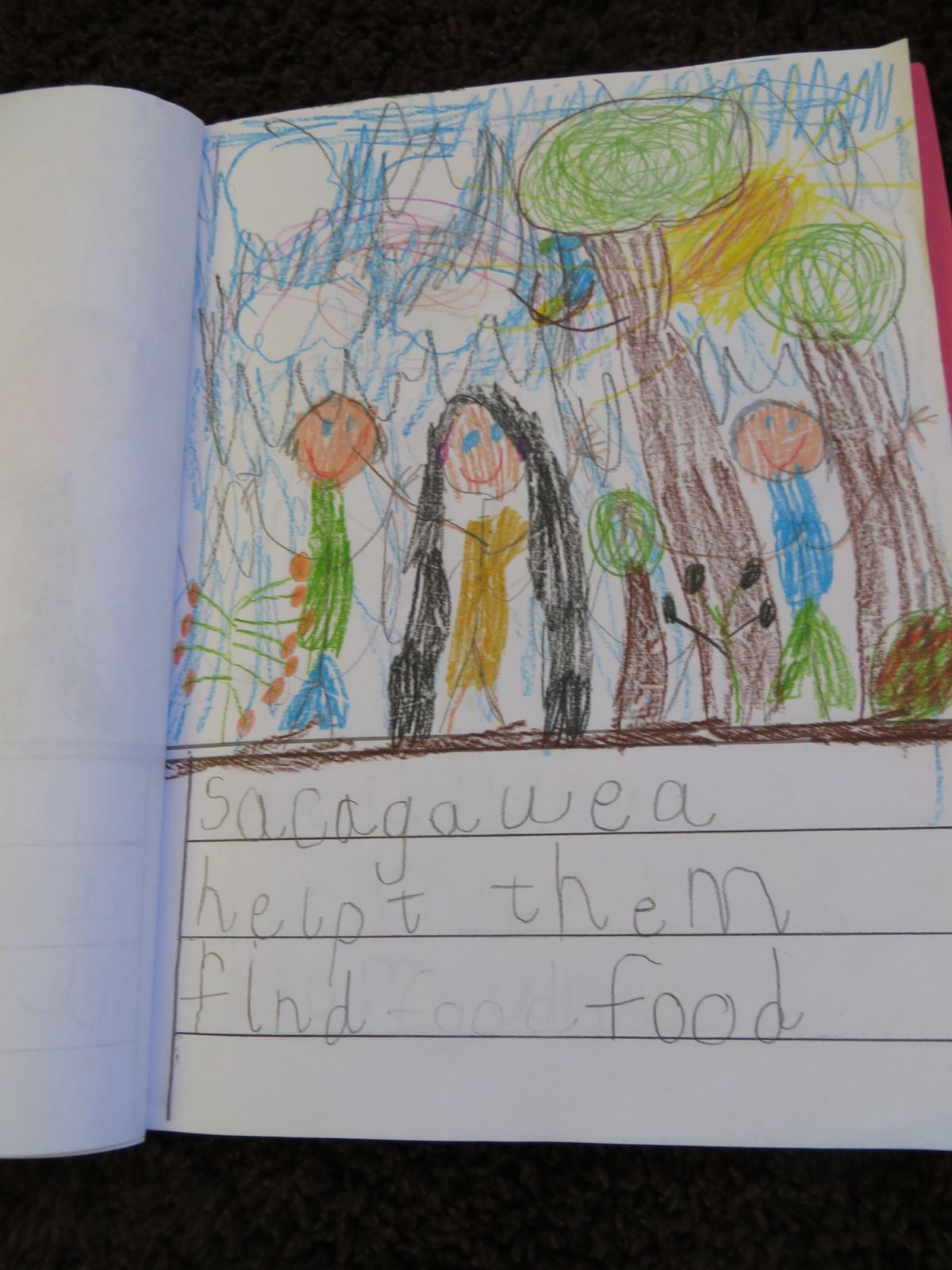
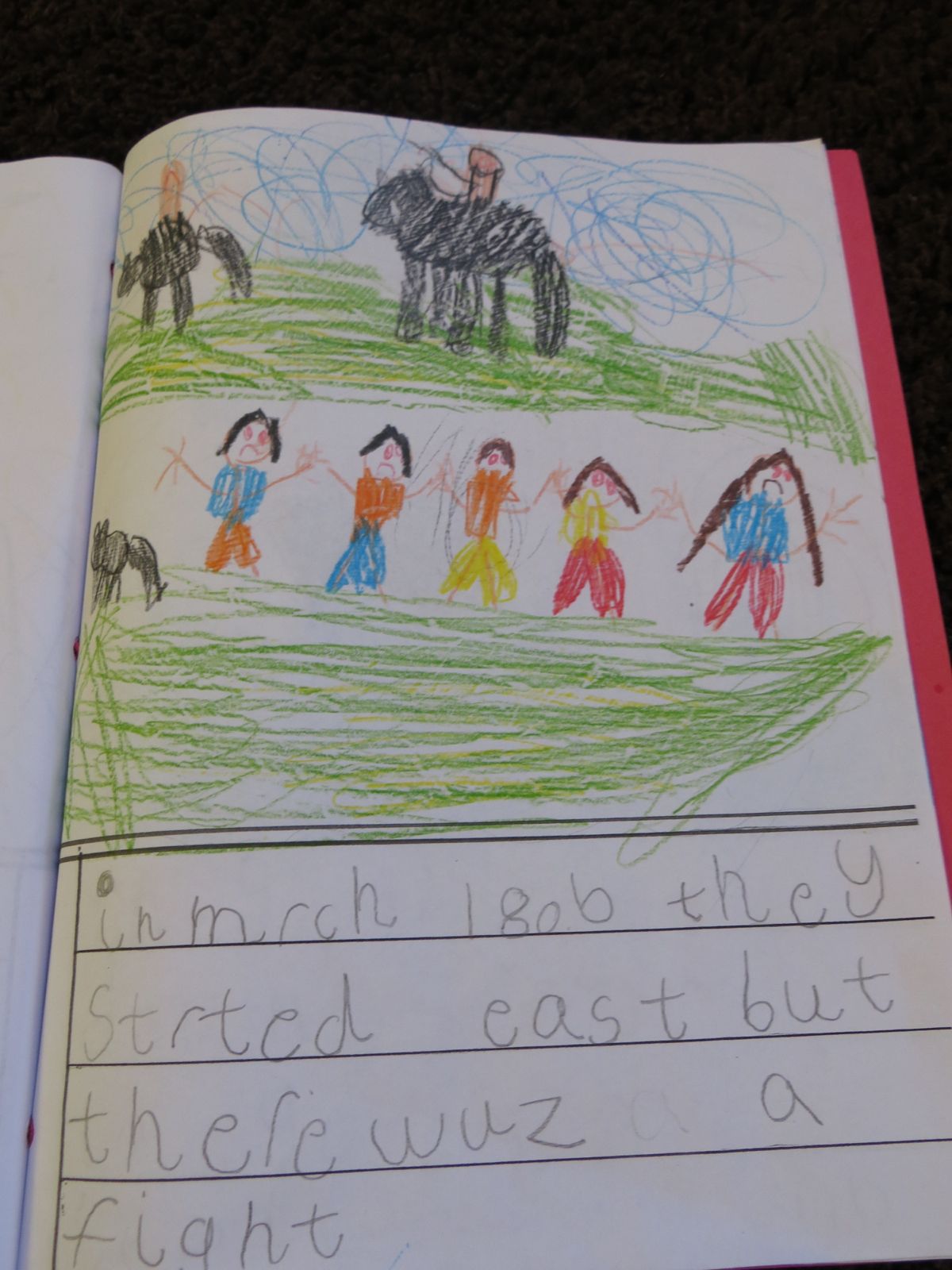
As it happens, these three oldest girls have been doing free writing in their "story folders" for many months now, it's a real passion for them, and this was the part I didn't anticipate.  They began to write the story bit by bit on their "story pages," and to draw picture after picture.  It became both a shared and separate project, sometimes they worked together, sometimes alone, each child just lit up about her own work.  I realized we should set these pages aside, and I began to tell them they were writing their own book.  Then we found out the date for Morgan's last day, which gave us an end goal.  Each of their books were finished last Friday, and they shared them and told the story to the whole group of children.

Their books were going home, so I photographed just some of their pages, randomly moving from one child's book to another - I gathered the tale with the camera.  This is what I want to share, a mix of their pages, with no names attached.  I have simply typed their words verbatim.    

two men livd in virginai, lewis and clark.


[Julian's brother Luca caught just a bit of the story early on, and created this]
They fild the keel boat with supleys in 1804
  
lewis and clark went on a long jrney

they brot gifts to the indians

lewis and clark, and seaman was a dog

they went up a long rivr

the bear got shot

Sacagawea had babe in wintr

Sacagauaya careed her baby

Sacagawea helpt them find food

sacagawea found hur bruthr

they crost the mountains

they rech the Pusific ocen in Novembr 1805

in march 1806 they strted east but there wuz a fight

they went down rivr to go home 1806

Here are our proud and beautiful explorers, Ava, Cara, and Morgan, as they finished this most wonderful part of their own "journeys of discovery."  As William Clark wrote in his journal when the Corps of Discovery first sighted the Pacific Ocean, "Oh the joy."


Tuesday, June 18, 2013

The first thing we had was a little pea


All our handling of the child will bear fruit, 
not only at the moment, 
but in the adult they are destined to become."
Maria Montessori

We sing a simple gardening song this time of year.  We act it out, when we're gathered inside.  We live it out, when we're gardening outside, one time after another. The song's lyrics go like this, with many variations:
(March 1)
"The first thing we had was a little pea (or 'seed'.... or 'bean'....)
The first thing we had was a little pea,
The frist thing we had was a little pea,
The Lord's gonna bless our garden."  (or sometimes, 'the Earth's'....)

(April 3)
"The next thing we had was a little shoot...."
[repeat as above]

(April 10)
"The next thing we had was a little root...."
[repeat]

(May 17)

(June 3)

(June 3)
"The next thing we had was a little vine...."  (or 'a great big vine'....)
[repeat]


(June 10)
"The next thing we had were a lot of peas....
[repeat]
The Lord (...or Earth...) has surely blessed our garden."

(June 10)
And yes, your children who may perhaps refuse many vegetables out of habit at the dinner table, have been eating chard and spinach and peas and lettuce and broccoli, garden to hand to mouth, throughout this spring.  It's a joy to see.

This brings me back to the Montessori quote at the beginning:  "All our handling of the child will bear fruit, not only at the moment, but in the adult they are destined to become."

[And now you can congratulate me on a simple blog with very few words!
Let the summer begin!]
(June 18)


Thursday, May 23, 2013

Africa!


"We shall walk together on this path of life, 
for all things are part of the universe, 
and are connected to each other to form one whole unity."
Maria Montessori

We've "left" Africa now, and I thought it would be good to remind you of our journey.  Every year at Chickadee we dive into an exploration of one continent.   Where do we begin?  With stories and picture books.   Then, over many weeks, we introduce different aspects of the land and culture, using music, pictures, animals, food, 3-part cards, maps, arts and crafts, and so on.  The children begin to develop some idea of another culture, different possibilities, the infinite variety of life on earth.  Last year it was Asia; last summer, Australia.  This spring it has been Africa.

We realize that we can't give children of this age anything like a real grasp of the size and the incredibly grand array of life on any continent.   Our mission is simply to plant seeds of awareness, and to nurture their budding sense of connection, wonder, and respect.  They are, after all, both present and future citizens of the global village.  

So we begin, again and again, with the globes and the puzzle map of the world.  We sing the song of the continents.  We match key animals to each continent.  We play bring-me games to help them firm up the vocabulary.  We connect cards and pictures and folders to the colors of the continents.  And slowly, slowly, over their years with us, with lots of repetition, the children begin to know and name earth's continents, biomes, and some countries.  

Here is Cara on the day she finished her pricked map of the world.  She labeled the continents and framed it with animal stickers.   She is bursting with pride; her finger points to the panda in the corner.


For this year's cycle, we focused on Africa.  The rest of this post shares some of the activities that the kids were doing (or if not doing, at least watching)  during this time.

Rhythm, movement, sound.  Ah music!  It offers a direct line to our consciousness.  Julian's mom brought in this great drum which she got during her own adventure in Africa.  These several ethnic instruments were in constant use; in the sunny weather the children took them out to the grass.  We also played a CD of African acoustic music, given to us by Lucas' dad Rob, and we are still singing an African lullaby.

Biomes.  Earlier in the year we introduced the biomes, part of every year's curriculum.  Here Noah is using the biome puzzle map of Africa, and we notice that Africa has lots of desert and lots of grasslands.  

Accompanying this map were sets of 3-part cards of animals for each major biome in Africa, and the simple biome readers, which are popular with every single child.  (Even though we have "finished" Africa, I left the biome readers out, because some children still use them every day.)  

  
Morgan traced, painted, and labeled that Africa biome map, a solo project that no one else chose to do.  Then each child in our "extended-day" group created chalk pastel images of different biomes or natural features of Africa.  They each chose a picture they liked in one of our books of narrative photographs - Mount Kilamanjaro, Sahara Desert, a beautiful waterfall, savannah....  Seen all together, this bulletin board was a teacher in itself, so we kept it up for several weeks.


The grand array of African animals. Every child loves African animals, and everyone used this collection.  It includes those iconic animals most children learn as toddlers - such as elephant, zebra, and lion - as well as some that are less familiar - kudu, meercat, wildebeest.   They read the labels, or had someone read them; they sorted them by the biome they live in; they drew them; they played "I Spy" with their initial sounds; and they played freely with them.  Lots of play.

The puzzle map of African countries.  The political map is a complex puzzle with so many countries (I still need the control map to put it together; several children do not.)    Often an older child would invite a younger child to do the puzzle map together.  We also put out 13 flags of Africa, and we have a flag book that tells about each one.  The older kids matched the flags to the countries, and started drawing flags. They would ask us to read to them from the book, to find out what the colors and symbols meant.  


Here you can see Ava holding the flag of Liberia (it was formed by freed slaves who returned to Africa, thus its similarity to the US flag).   She also noticed that Sudan is one piece in our puzzle map, but the paper map she was coloring had it split in two, so we talked about how the people there recently decided to divide the land into two countries.   (For obvious reasons we talked very little about present-day political Africa, so much suffering.   I did find a nice book on Nelson Mandela.)

Leo created this impressive paper map of Africa.  In the last two years he has repeated all the puzzle maps so many times, and mastered them all.  He started pricking some African countries on his own, when we were still doing vertebrates, and no focus on Africa had been suggested.  He worked on them on and off, in the midst of all his other activities.  When the countries were all done, he glued them all down from top to bottom; then he carefully pricked out the countries too small to have their own puzzle piece, noticing every single detail he could find.  He felt such well-deserved pride and satisfaction from accomplishing this big work.


Village life.  Along with the many books we found at the library, we used a set of hand-made cards to show rural African people and many different aspects of their lives.  These little cards inspired drawings and writing. Above is one child's stylized rendition with the green cards she used laid out on the paper.  On the right is another. To go with her scene, this child wrote, "mom cooks bred in africa."  The idea of an outside clay oven heated by fire made a big impression.  

Art.  
Throughout these many weeks, related arts and crafts were happening. Simple things like the noodle necklaces, or these African masks, which didn't turn out very "ethnic" but were lots of fun.  We told the kids they were really more for hanging than for wearing, and some of them could tell stories about what their masks symbolized, like, "This is plants, and earth, and rain." 

Here is Lucy's vibrant zebra.  She used an Eric Carle picture card as a guide.   She drew the parts of his body with very little help, cut them out, and cut and glued down every stripe.  She was so proud of how the legs made him look like he's really moving.  


We closed the Africa cycle with our "paper people." Creating them is such a sweet process.   We might marvel at all the beautiful browns of their skin, asking, "Which color of skin do you want to use this time?"  Referring to one of our picture books, one of us might say, "Look at all the bright fabrics in their clothes!" or,  "The desert people cover themselves with white to stay cool and protected,"  and then ask, "Which clothes do you want to use for this person?"  As the last step, the child draws the person's face, two eyes, one mouth, always such a genuine expression of their pure experience and ability right in the moment.   We hope you love the African paper people who make their way home to you!     


"I dream of an Africa which is in peace with itself."   Nelson Mandela